Quick answer
In England and Northern Ireland, first-time buyer relief (0% stamp duty up to £300,000, 5% from £300,000 to £500,000) only applies if every buyer is a first-time buyer who will live in the property.1 If your partner has ever owned a home, anywhere in the world, you both pay standard rates: on £350,000 that is £7,500 instead of £2,500. If your partner still owns a home and keeps it, the 5% higher rates apply on top, taking the bill to £25,000.2
Key takeaways
- Every buyer must be a first-time buyer and intend to live in the home as their main residence.1
- A first-time buyer has never owned a freehold or leasehold interest in a home anywhere in the world, including an inherited share.1
- No relief above £500,000, whoever is buying.1
- If any buyer still owns another home at the end of completion day, the 5% higher rates apply to the whole price.2
- Married couples and civil partners are treated together for the higher rates, even if only one is on the purchase.2
Stamp duty relief for first-time buyers is generous: no tax on the first £300,000. But it is all or nothing for the people on the purchase. One buyer who has owned a home before, even years ago or abroad, removes the relief for both of you.
This guide covers England and Northern Ireland (SDLT) for 2026/27. Scotland's LBTT and Wales's LTT have their own first-time buyer rules, covered in the Scotland and Wales guides.
Worked examples: stamp duty for a home mover
| Price | England/NI tax | Scotland tax | Wales tax |
|---|---|---|---|
| £300,000 | £5,000 | £4,600 | £4,500 |
| £500,000 | £15,000 | £23,350 | £18,000 |
| £750,000 | £27,500 | £48,350 | £36,750 |
Who counts as a first-time buyer for stamp duty?
For SDLT, a first-time buyer is someone who has never owned a major interest in a residential property, freehold or leasehold, in the UK or anywhere else in the world.1 It does not matter how long ago, how small the share was, or whether it was inherited. Shared ownership in the past usually counts as ownership too.
Every purchaser must meet the test and must intend to occupy the property as their only or main residence. The price must be £500,000 or less.1
What does it cost if your partner has owned before?
Three couples buying the same £350,000 home in England, completing in 2026/27:
| Situation | Rates used | Stamp duty |
|---|---|---|
| Both first-time buyers | First-time buyer relief | £2,500 |
| Partner sold their old home before completion | Standard rates | £7,500 |
| Partner still owns a flat and keeps it | Higher rates (+5%) | £25,000 |
Standard rates: 0% to £125,000, 2% to £250,000, 5% to £925,000. Relief: 0% to £300,000 and 5% to £500,000. Higher rates add 5% to every band. Figures from the site's SDLT calculator.
The jump from £2,500 to £7,500 comes from losing the relief. The jump to £25,000 comes from the higher rates, which apply when any buyer owns another home worth £40,000 or more at the end of the day of completion and is not replacing their main residence.2
Can you buy in one name to keep the relief?
If you are not married or in a civil partnership, buying in the first-time buyer's sole name keeps the relief, provided they are the only purchaser. The partner who has owned before then has no legal share in the home, which matters if you split up, and lenders will still ask about everyone living there.
Be careful with a declaration of trust giving the other partner a share: someone with a beneficial interest can be treated as a purchaser, which can bring the relief back into question. Ask your conveyancer before exchange.
If you are married or in a civil partnership, buying in one name does not avoid the higher rates when your spouse still owns a home: HMRC treats spouses as one unit unless you are separated.2
What if your partner is selling their old home?
If your partner's previous home is sold on or before completion day, the higher rates do not apply, but the first-time buyer relief is still lost because they have owned before. Budget for standard rates.
If the sale completes after your purchase, you pay the higher rates first. Where the home being sold was their only or main residence, you can claim back the 5% surcharge if it is sold within 3 years of buying the new one.2 Plan the cash for the surcharge either way: the refund only comes after the sale.
Checklist before you make an offer
List every property each buyer has ever owned, anywhere, including inherited shares and shared ownership.
Tell your conveyancer and mortgage broker early, so the stamp duty figure in your budget is the real one.
If one partner still owns a home, decide whether it will be sold before completion; if not, budget for the higher rates and the refund timing.
Run the stamp duty calculator for each buyer type at your target price and keep the higher figure in your budget until the conveyancer confirms it.
Use the calculator for this topic
Frequently asked questions
Can I get first-time buyer stamp duty relief if my partner has owned a house?+
Not if your partner is buying with you. Every buyer must be a first-time buyer for the relief to apply, so you pay standard rates on a joint purchase. On £350,000 that is £7,500 instead of £2,500.
Does owning a home abroad stop first-time buyer relief?+
Yes. The test covers residential property anywhere in the world, not just the UK.
Does an inherited share of a house count?+
Yes. Owning a share of a home, including one you inherited, means you are not a first-time buyer for SDLT.
My partner still owns a flat. Do we pay the 5% surcharge?+
Yes, if they still own it at the end of completion day and it is worth £40,000 or more, and the new home is not replacing their main residence. If the flat was their main home and is sold within 3 years, the surcharge can be reclaimed.
Can I buy in my name only to keep the relief?+
If you are unmarried and the only purchaser, yes, but your partner then has no legal share. If you are married or in a civil partnership and your spouse owns a home, the higher rates can still apply.
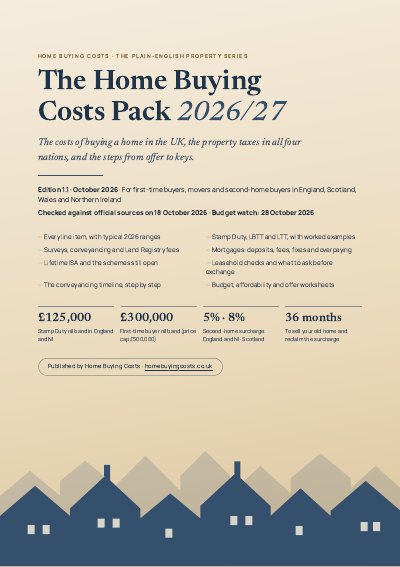
Home Buying Costs Pack 2026/27 · £4.99
Every cost of buying, and when you pay it.
A 30-page pack with Stamp Duty, LBTT and LTT worked examples, the offer-to-keys timeline, a before-you-exchange checklist and budget worksheets.
See inside the pack →Not sure what to budget or check next? Answer six quick questions and get your upfront costs and a checklist for your stage. Free, no email needed.
Get my free home-buying check →Sources & references
OfficialThe figures and rules on this page are drawn from the official UK government sources below. Rates are the confirmed 2026/27 amounts. Each link opens the relevant official page in a new tab.
- GOV.UK: Stamp Duty Land Tax residential rates (first-time buyers) www.gov.uk/stamp-duty-land-tax/residential-property-rates First-time buyer relief: £300,000 nil band, £500,000 limit.
- GOV.UK: higher rates for additional residential properties www.gov.uk/guidance/stamp-duty-land-tax-buying-an-additional-residential-property 5% surcharge, spouses and civil partners, replacing a main residence.
Verified against published UK government guidance. See also Methodology and Editorial standards.